The Roster accelerator (FS Roster) lets an admin build a no-code, portal-facing table or tile grid that shows a defined set of records and, if allowed, lets the logged-in user add, edit, or delete them. The most common use case is an organization roster: a company’s primary contact logs into the portal and manages the other people tied to their account — adding a new employee, correcting a phone number, or removing someone who’s left. Everything about one roster — the object, which records show, which fields are visible or editable, and who can see or edit it at all — comes from a single configuration record.This accelerator requires the fusionSpan Common Base Library as a prerequisite install, and is not part of core fusionCore.
Enable Lightning Web Security (Setup → Session Settings → “Use Lightning Web Security for Lightning web components and Aura components”) — required for the tile display option. Test this in a sandbox first, since enabling it org-wide can affect other components.
Assign the FS Roster Platform permission set to portal/end users, and FS Roster Administration to the admins who will build rosters.
Create a Roster_Setting__c record. Set Object_to_Display__c to the API name of the object the table should show, and give it a Roster_Title__c.
2
Scope which records show
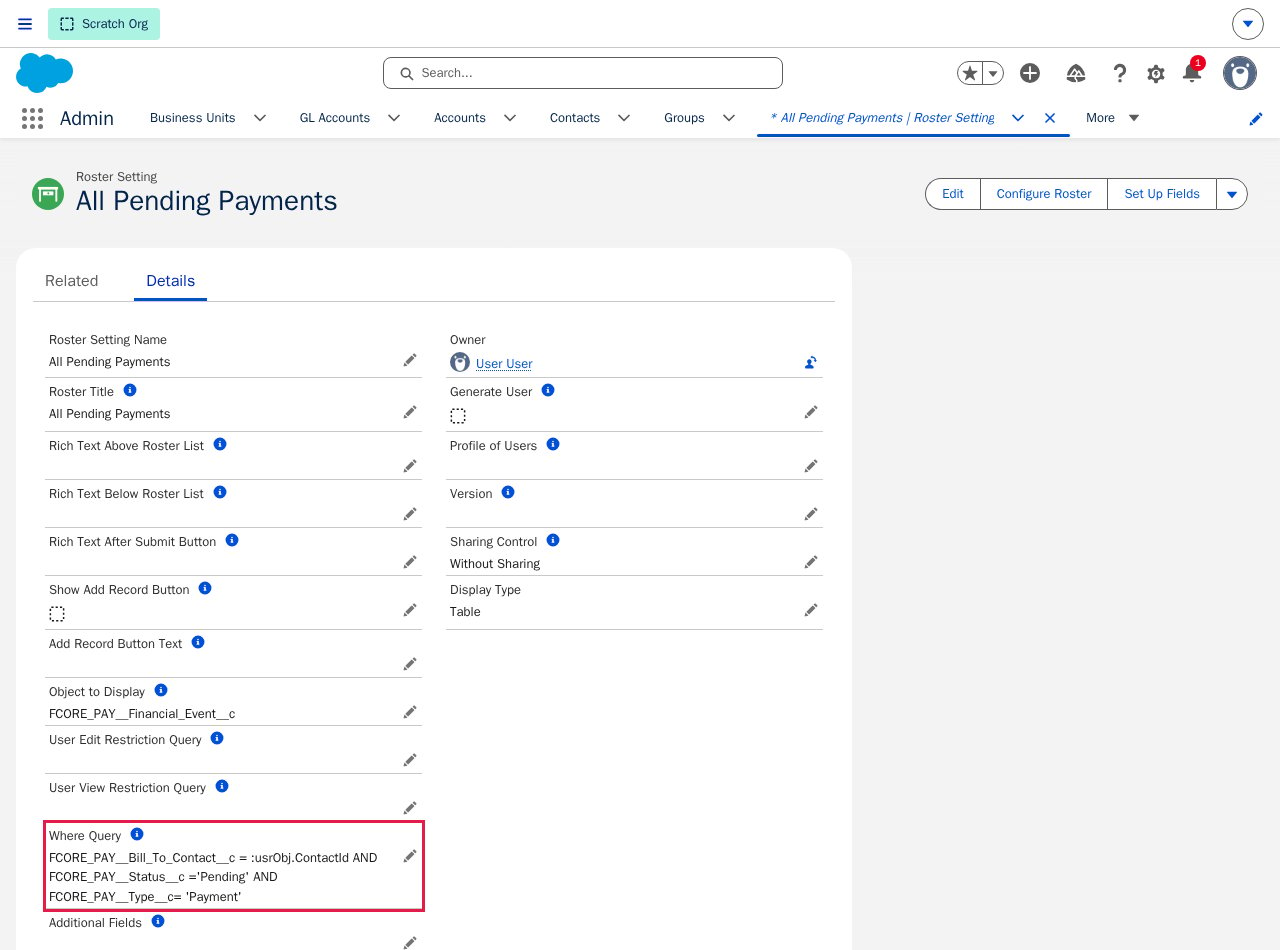
Set Where_Query__c to filter the records — use the token :usrObj.<field> to scope by a field on the logged-in user, for example showing only Contacts on the same Account.
A real Roster Setting used to show a portal user their own pending payments
3
Configure the columns
Click the record’s Set Up Fields quick action to choose which fields the roster shows and how each one behaves — see Setting Up Fields below for the full set of options.
The Set Up Fields quick action on a Roster Setting record
4
Set access control
Configure User_View_Restriction_Query__c to control who can open the roster at all (failing this blocks the whole roster), and User_Edit_Restriction_Query__c to control who gets edit rights versus read-only access.
5
Choose sharing and behavior
Set FS_Sharing_Control__c to With Sharing for internal use, or Without Sharing for portal scenarios where users need to see records beyond what their sharing rules would normally allow. Configure the add/delete/highlight-edits toggles and any rich text you want shown above or below the table.
6
Choose the display and place the component
Set FS_Display_Type__c to Table or Tile, then add the FS Roster Table Lightning web component to your Experience Cloud or Lightning page, pointing it at the Roster Setting record.
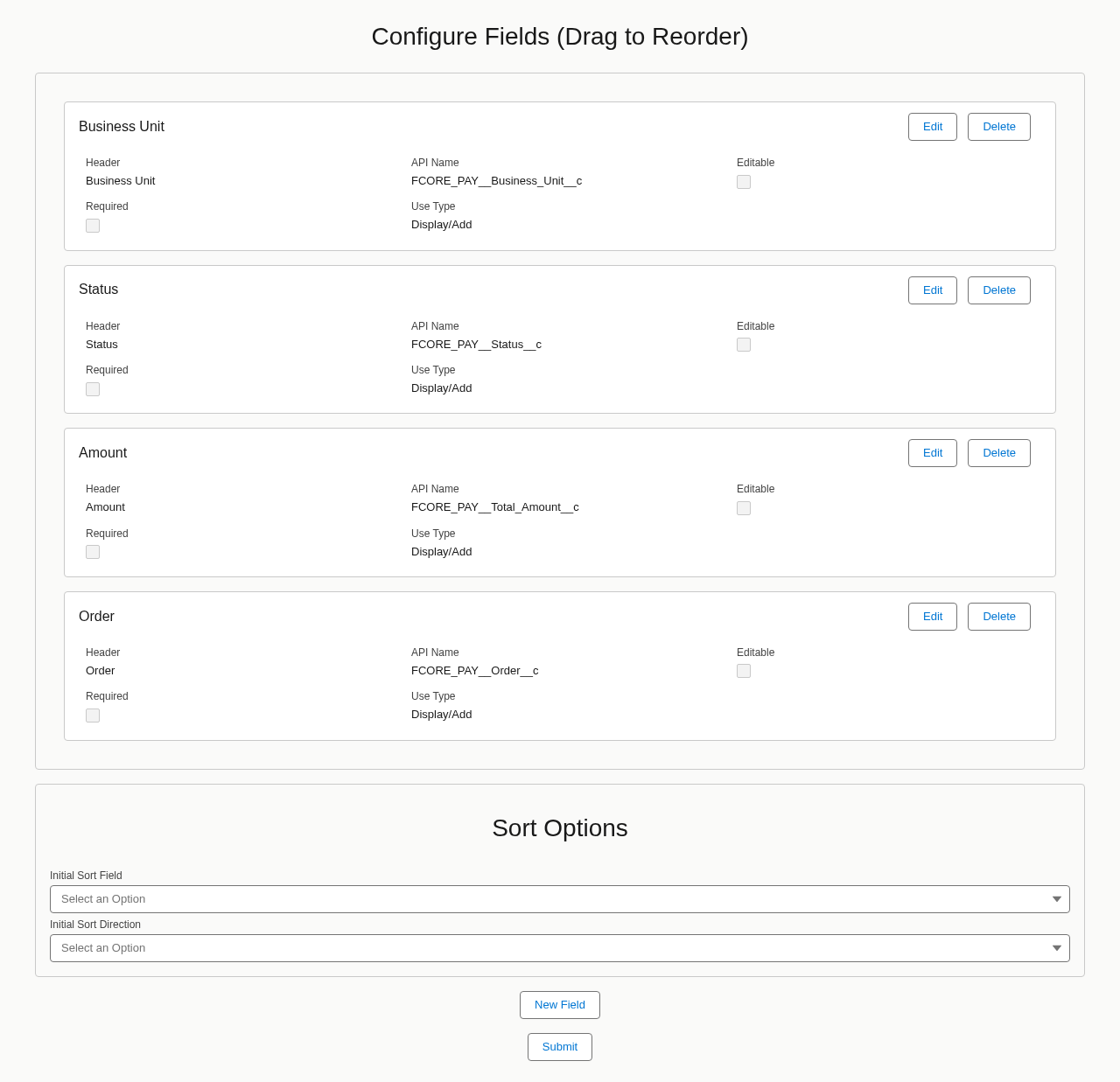
Set Up Fields is a quick action on every Roster_Setting__c record. It’s the only supported way to build the field configuration — it writes a JSON blob to Fields_Settings__c behind the scenes, but don’t edit that field directly; use the quick action so the JSON stays valid.Opening it shows Configure Fields, a card for every field already configured, each with Edit and Delete buttons. Drag a card to reorder it — this controls both column order in the table and the order fields appear in the Add/Edit form. Below the list, Sort Options sets which field the roster sorts by initially and in which direction. Click New Field to add another, and click Submit (or Next — see below) when you’re done.
The Configure Fields screen for a Table-display Roster Setting, showing four already-configured fields
Clicking Edit or New Field opens the Field modal. Every field, regardless of type, has these options:
Setting
What it does
Header (required)
The column label shown to users.
API Name (required)
The field to show, chosen from a dropdown listing every field on the roster’s Object_to_Display__c. You can’t type an arbitrary API name — it must already exist on that object — but any field type is allowed (text, number, date, checkbox, picklist, lookup, and so on). Picklist and Lookup fields unlock extra options, described below.
Display or Add (required)
Controls where the field shows up. See the table below — the three values behave differently in a way that isn’t obvious from the label.
Editable
Only matters when a user edits an existing record. A field always accepts input while a record is being added (as long as Display or Add includes Add); Editable decides whether the same field can still be changed once the record already exists.
Required
Makes the field mandatory wherever it renders as an input. Has no effect on a field that only ever shows as a read-only column.
Help Text
Optional field-level help text shown next to the input in the Add/Edit form.
Display or Add isn’t as simple as “Display = table, Add = form.” The value determines three things independently:
Value
Shows as a table/tile column
Shows in the Add form
Shows in the Edit form
Display
Yes
No
Yes
Add
No
Yes
No
Display/Add
Yes
Yes
Yes
An Add-only field appears when a user creates a new record, but disappears once that record is saved — it never shows as a column and never appears again when the user edits the record later. Use Display/Add for a field you want visible everywhere.
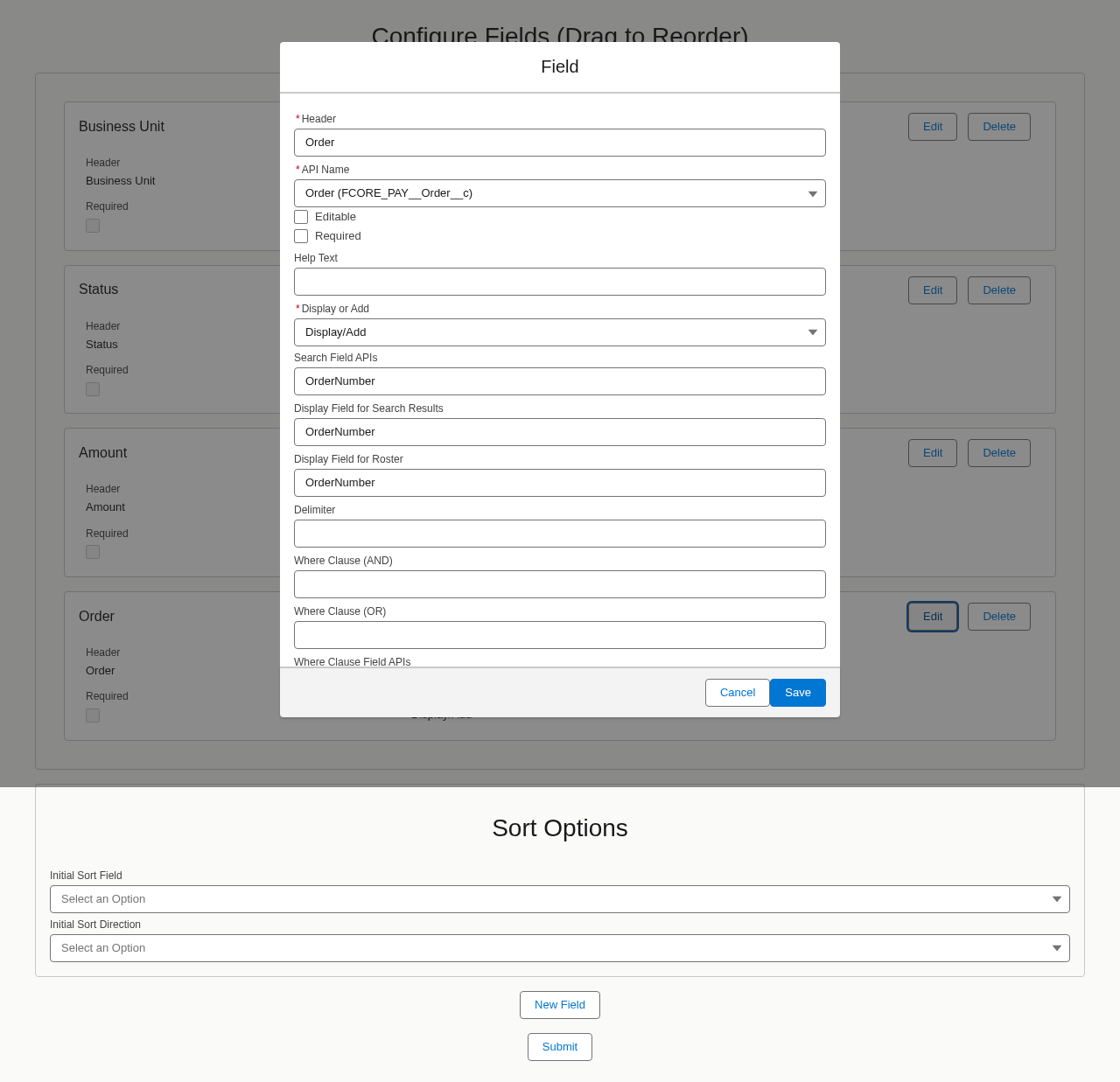
Setting API Name to a lookup field adds these options, which control the search box the user sees when they click into that field in the Add/Edit form:
Setting
What it does
Search Field APIs
Field(s) on the related object checked when the user types a search term.
Display Field for Search Results
Field shown for each match in the search dropdown.
Display Field for Roster
Field shown in the table or tile once a value is chosen.
Delimiter
Separator used when more than one field is concatenated for display.
Where Clause (AND) / Where Clause (OR)
Extra filter criteria that narrow which related records are searchable. Like Where_Query__c, these support the :usrObj.<field> token to scope by a field on the logged-in user.
Where Clause Field APIs
The field(s) referenced by the Where Clause filters above.
The Field modal for a lookup field (Order), showing the lookup-specific search options
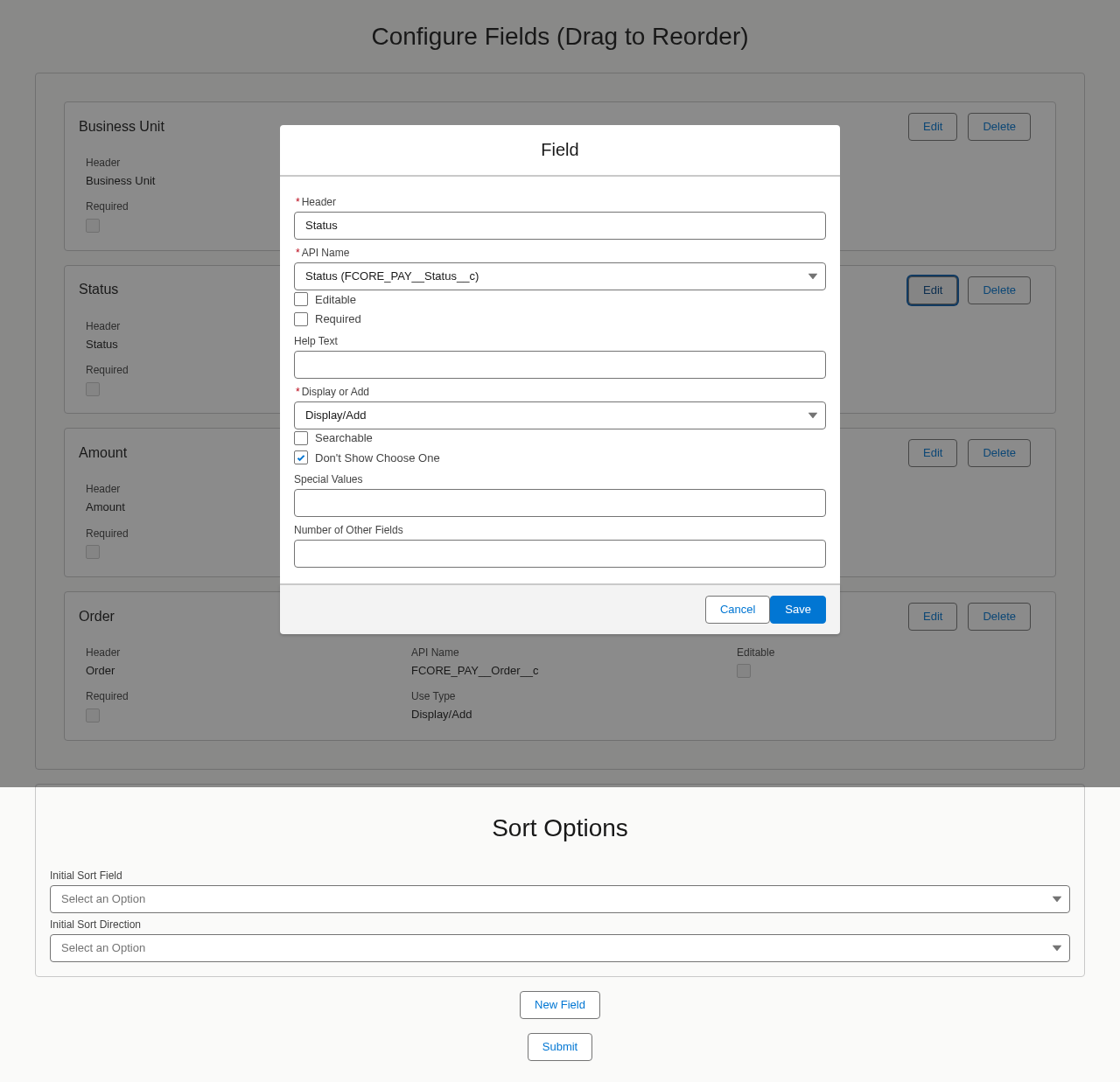
Setting API Name to a (single-select) picklist field adds:
Setting
What it does
Searchable
Meant to add a search box inside the picklist.
Don’t Show Choose One
Meant to hide the blank default option.
Special Values
A comma-separated list of picklist values (for example Other) that, when selected, reveal the extra fields configured below.
Number of Other Fields
How many extra fields to reveal when a Special Value is picked. Enter a number and a row appears for each one — set its own field API, label, and help text — so a user picking “Other” can specify something the picklist doesn’t cover.
The Field modal for a picklist field (Status), showing the picklist-specific options
A multi-select picklist field only gets the plain options from the table above — the Searchable/Special Values extras in this section apply to single-select picklists only.
If the Roster Setting’s Display Type is Tile, clicking Next instead of Submit after the field list takes you to a second screen, Configure Tile View, where you choose how the tile itself renders (an LWC template, rich text, or raw HTML) and set filterable/sortable fields and tiles per page. The field-by-field options above are identical for Table and Tile rosters — this extra screen only configures the tile’s visual layout, not the fields themselves.
Configuration mistakes throw a specific error, not a blank table. A blank object, blank field settings, or a referenced field the user can’t access all produce a hard error rather than an empty table — read the error message, it names the specific problem.
The Searchable and Don’t Show Choose One picklist options don’t currently do anything. They save to the configuration, but the current Add/Edit form doesn’t apply them — a configured picklist field always renders as a standard dropdown with the default blank option, regardless of these two checkboxes.
Fields_Settings__c is a single Long Text Area (131,072 characters). There’s no explicit limit on how many fields you can configure, but every field’s options are serialized into that one field — a roster with a very large number of fields, especially lookups or picklists with several “other fields,” can run into that character ceiling.
View and edit restrictions behave differently. Failing the view restriction blocks the entire roster from loading; failing the edit restriction just makes it read-only. Don’t rely on the edit restriction to hide a roster from anyone — use the view restriction for that.
Row-count limits and field allow-lists live in separate Custom Metadata, not on the Roster Setting itself. If you need to cap how many records a roster can return, or restrict which fields it’s allowed to query, that’s configured on the underlying SOQL Query Builder settings, not the Roster Setting record.
Automatic portal-user creation for newly added records is not fully implemented, even though it’s exposed as a setting on the Roster Setting record. Don’t rely on it for production without testing it first in your org.
Only the current Lightning web component (fsRosterTable) is supported for new rosters. Older Aura-based roster components exist in the package for backward compatibility but shouldn’t be used for new work.
Assistant
Responses are generated using AI and may contain mistakes.